


The Self-Teaching Word Mapping Brain
Word Mapping Mastery® with Mapped Words®
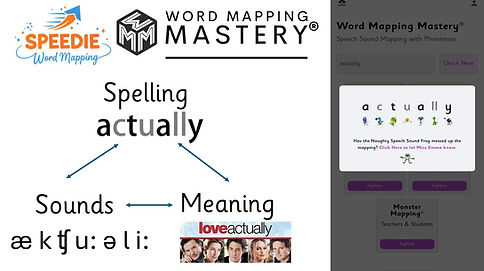
The Self-Teaching Word Mapping Brain
The brain doesn’t learn words by seeing letters alone.
It learns when sounds, spelling and meaning bond.
This bonding process is what orthographic mapping theory actually describes. A word becomes known when its sound structure, its spelling, and its meaning are securely connected in memory. Not loosely associated. Bonded.
This is the foundation of the self-teaching word mapping brain.
Orthographic mapping is about bonding, not exposure
Orthographic mapping isn’t about repeated exposure to print.
It’s about forming a permanent bond between:
-
Sounds: the spoken structure of the word
-
Spelling: how those sounds are represented in print
-
Meaning: what the word refers to
If any one of these is missing, unclear, or guessed, the bond doesn’t form. The word remains unstable. Reading and spelling stay effortful.
Self-teaching only begins once this bond exists.
Why seeing the code matters
The brain can’t bond what it can’t see.
When spelling patterns are hidden, implied, or inconsistent, the learner can’t align sounds with spelling accurately. That prevents the brain from forming a reliable connection to meaning.
Showing the code makes the structure of the word explicit. It allows the learner to check, adjust, and confirm how sounds map onto spelling, so the bond can form correctly.
This is why visibility matters. Not as a teaching aid, but as a cognitive requirement.
Why The Spelling Routine is essential
Showing the code and using The Spelling Routine support Word Mapping Mastery® by ensuring that sounds, spelling and meaning are accurately bonded. Each successful encounter strengthens the bond, allowing the self-teaching word mapping brain to operate independently. .
It ensures the learner actively connects:
-
The sounds in the spoken word
-
The spelling that represents those sounds
-
The meaning of the word being stored
This isn’t memorisation. It’s not repetition. It’s deliberate bonding.
By working from spoken word to spelling, the brain has to attend to every sound, assign it to print, and anchor it to meaning. That process is what creates a fully mapped word.
Once a word is bonded, it can be read and spelled automatically.
Self-teaching emerges from bonded words
A self-teaching brain isn’t one that’s been taught more.
It’s one that can create new bonds independently.
When learners understand how sounds, spelling and meaning connect, they can map new words without help. They can self-correct. They can store words accurately. They can generalise across the system.
This is the moment self-teaching begins.
Show the code. Build the bond. Let the brain do the rest.
Self-teaching doesn’t come from guessing or remembering.
It comes from bonded word knowledge.
That’s why we show the code.
That’s why we use The Spelling Routine.
Because once sounds, spelling and meaning bond, the brain takes over.
Why all of this matters
This matters because reading and spelling only become effortless when sounds, spelling and meaning are bonded in memory.
When that bond doesn’t form, learners don’t just read slowly. They experience uncertainty. They hesitate. They guess. They avoid writing. Over time, they conclude that reading isn’t for them.
That’s not a motivation problem.
It’s a mapping problem.
Unbonded words create fragile readers
When learners see words but can’t align sounds, spelling and meaning, words remain unstable. They may recognise a word one day and miss it the next. They may read it but not spell it. They may know what it means but not how it’s built.
Without a bond, there’s no reliable retrieval.
This fragility disproportionately affects:
-
Dyslexic learners
-
Neurodivergent learners
-
Learners with speech and language differences
-
Learners who don’t intuit the code
These learners don’t need more practice. They need the structure to be visible so bonding can occur.
Bonding is what creates independence
When sounds, spelling and meaning bond, something shifts.
The learner no longer depends on prompts, cues, or reassurance. They can check words for themselves. They can fix their own errors. They can approach unfamiliar words with confidence rather than fear.
This is the point at which the brain becomes self-teaching.
Independence isn’t taught. It emerges when word knowledge is secure.
Why hiding the code has consequences
When the code isn’t shown, learners are forced to compensate. They memorise. They guess from context. They rely on pictures. They watch adults’ mouths. They avoid spelling altogether.
These strategies can look like reading, but they don’t build bonded word knowledge. Over time, the gap widens between learners who can self-teach and those who can’t.
The cost isn’t just academic. It affects confidence, participation, and identity as a learner.
Showing the code is an equity issue
When word structure is made visible, access changes.
Learners who were previously excluded can finally engage on equal terms. They’re no longer expected to infer what others intuit. They’re given the same opportunity to build bonded words and become independent readers and spellers.
This is why showing the code matters.
This is why The Spelling Routine matters.
Not because learners need more teaching, but because their brains deserve the information required to form the bond.
Bond the word. Unlock the brain.
When sounds, spelling and meaning bond, the brain doesn’t wait to be taught.
It teaches itself.
That’s why all of this matters.
Word Mapping Mastery
Children who become great readers have developed word mapping mastery, and ironically, if we start the right processes early, they often need very little direct instruction. However, once they start school the teacher has to teach systemtically and explicitly. In England they will work through around 100 GPCs. See the chants video and strips. Children will be tested at the end of Year 1.
It's not enough to read though - these are simply to kick-start the process of self-teaching. Some will start self-teaching, and will be fine. At least 1 in 4 won't. Ten Minutes a Day, With a TA, is designed to catch those children so that they start self-teaching along with the others. Prevention is far easier than intervention at 8.
The critical window to prevent reading and spelling difficulties starts to close quickly, so if children are being taught in school, we must ensure they reach the self-teaching phase before the end of Year 1. This means that the more they read, the more they learn about reading.
To achieve this, we need to give them a strong kick-start in word mapping in both directions: understanding which sounds the graphemes in a word represent (decoding) and which graphemes represent the sounds (encoding or spelling). Children who read and spell easily use this kick-start to draw on all available cues, but what distinguishes highly skilled readers is that they recode. When they realise a word is fairy, for example, they mentally track back to identify which sounds they used and which graphemes represent those sounds.
Every word can be mapped in this way, with every sound mapping to letters (and no letters left unused, apart from a few exceptions such as one and once, and some words borrowed from other languages.
This level of word mapping mastery also allows children to recognise when the words in their phonics books have been mapped incorrectly!
Let's ensure that children are able to see how words map, regardless of which materials they are given at school.
A simple way to think of it: the norm is one phoneme, one grapheme.
h–air–y doesn’t align with the prinicples of phonics.