


Teach your child to read and spell.


English has an opaque orthography, so we reduce cognitive load and support self-teaching by showing the brain which letters form graphemes and their sound value.
Phonemies are IPA-aligned Speech Sound Monsters that make phonemes visible.





The Quickest Way to Help Your Child Read if They’re Struggling at School (Aged 5–8)

Supporting Brains Differently. One, Two, Three and Away! with The Code Overlay
When a child between five and eight is finding reading difficult at school, the fastest way forward is to check they know the Core Code. That means quickly learning around 100 key grapheme–phoneme correspondences so they clearly understand how spoken sounds connect to written letters. This is the SSP Core Code, and it has four Core Code Levels!
Children can build this knowledge using the 2 Minute Monster Moves video, the Monster Spelling Piano app on a tablet, and the SSP Chants videos. Together, these help them learn the code and the sounds of the Phonemies in a consistent, memorable way, so that they can confidently start exploring the books.
After completing the Green and Purple Code levels, even before finishing the others, children move into the One, Two, Three and Away reading series with The Code Overlay in place. The books are available through the online library at SpeedieReadies.com, and printable versions can be found in the “One, Two, Three and Away with The Code Overlay” handbook.
With The Code Overlay supporting them, children can see how each word is constructed. Instead of guessing or relying on memory, they learn to analyse words accurately. The stories are carefully structured and sequenced so that children experience success early and build real reading confidence.
There are three versions of The Code Overlay, and children use them for as long as needed, gradually reducing support as their independence grows.
Throughout this stage, they continue expanding their Core Code knowledge, and are mapping words from speech-to-print as well as print-to-speech.
That’s when reading begins to feel manageable, and progress accelerates. Cognitive load is reduced at all stages, so that the meaning of the words are the focus. The Code Overlay boosts orthographic learning, but the stories about The Village With Three Corners ignite a love of reading for reading's sake.


Ask your local library to stock The Village With Three Corners series so that you can read them at home! UK libraries primarily order books and resources through specialist library wholesalers and suppliers, such as Askews & Holts, Gardners, Peters, and ProQuest. Send them the list of ISBNs!
How to Prevent Reading and Spelling Struggles Before They Begin
How did you learn to read?
How do you read?
Do you know?
Understanding reading and spelling is what we do.
Speedie Readies is part of a developmental pathway towards Word Mapping Mastery® that supports children to reach self-teaching by building the prerequisites first, then flooding the system with high-interest mapped words and an early introduction to the One, Two, Three and Away! series. Adults who learned to read with these books about The Village With Three Corners in the 1980s and 1990s still talk about them on social media. They shaped childhood memories and started many children on a path towards lifelong reading. You will see them mentioned fondly by those advocating for play-based learning and reading for pleasure, such as Greg Bottrill, author of Can I Go and Play Now? Rethinking the Early Years.
The goal of early and speedie self-teaching is for the child to be intrinsically motivated to read for pleasure, because no teaching can make a child a reader. Most learning to read happens implicitly, through engagement with text the child is motivated to read, once the conditions for self-teaching are in place. My role is to help you create those conditions. As Greg so wisely says "Education done with children, not to them"
Emma Hartnell-Baker "The Word Mapper"
aka The Neurodivergent Reading Whisperer®
The Language Used by Word Mappers
Word Mapping Phrases and terms are here
Do you have a question? Email Miss Emma @ Support@WordMappingMastery.com

Who is Word Mapping Mastery training for?
-
Parents and carers of children from birth to seven, when the brain self-teaches most easily.
-
Early Years practitioners and teams who want to better support speech sound processing, oral language development, and early connections between speech and print, separate from any phonics programme.
-
Those supporting children from birth who are learning to speak English, including children growing up with more than one language.
-
Those supporting children who are non-speaking, and not yet reading or writing, who need accessible ways to connect speech, print, and meaning.
-
Parents and tutors of dyslexic children, or children at risk of reading and spelling difficulties, who want an approach that reduces cognitive load and supports self-teaching.
-
Parents of autistic children, children with ADHD, and children with co-occurring neurotypes, particularly those who are strong pattern seekers and prefer a logical, almost mathematical approach to word mapping. This includes children who do not respond well to rules, memorisation, or guesswork, and who benefit from being able to click to see the code whenever they choose. Many of these children are autodidactic. They do not want to be taught. They want to figure things out independently.
-
Anyone supporting individual children one-to-one who wants to move away from traditional phonics lessons, worksheets, and explicit instruction, and instead focus on child-led, schema-driven learning that centres on the learning journey rather than a specific outcome.
-
Those who prefer to explore word mapping within a meaningful series of books, rather than through isolated phonics activities, so that reading develops through context, story, and enjoyment.
-
Those who want learning to read and spell to be part of daily life, as a natural extension of play-based and everyday activities, such as building shopping lists, playing shops, reading a book on your own for the first time or building worm farms !
When children are blending Phonemies and their focus is only on the Speech Sound Monsters, even if the graphemes are visible, I refer to this as Speech Sound Mapping. I think these separate terms are important because they indicate what the brain is doing. This distinction between Code Mapping (word mapping without Phonemies) Monster Mapping (word mapping with Phonemies) allows us to separate phonemic awareness from decoding and encoding, both with and without Phonemies. See Language for Word Mappers

All of the activities in this training are designed with one goal in mind: to kick-start self-teaching so that children experience deep reading as quickly and as easily as possible.
Deep reading is the point at which reading stops feeling like work. Words are recognised efficiently, attention stays on meaning, and reading becomes immersive rather than effortful. This is when children begin to read for pleasure, not because they are told to, but because they want to.
If children do not reach this point early, before around age seven, there is a real risk that it never happens. They may learn to decode. They may cope with short texts. But they never choose to read a whole book, and they never experience the joy that keeps readers reading. Without that joy, reading simply does not compete with everything else that begins to demand their attention as they get older.
That is why this training prioritises early access to real books. We use the One, Two, Three and Away books as early as possible so that children are not just learning the code, but actively self-teaching through text and experiencing reading for pleasure from the outset.
When children experience success and enjoyment early, reading becomes self-sustaining. When they do not, no amount of instruction later can easily replace what was missed.
This matters more than ever. Reading for pleasure is now at a twenty-year low in England. While this decline is part of a broader international trend, it is particularly stark in England. If children do not associate reading with meaning and enjoyment early on, many simply opt out.
This training exists to prevent that outcome. The activities are designed to help children cross the threshold into deep reading, so reading becomes something they choose, not something they endure.
That is why we are seeking funding to offer free dyslexia risk screening to all three year olds, alongside early support for families before their child starts school. It is also why we have launched the Prevent the Dyslexia Paradox pilot for schools, Ten Minutes a Day, With a TA. The focus is on identifying risk early and creating daily opportunities for successful, meaningful reading before avoidance and frustration take hold.
If you are here because your child, or the child you support, is older than seven, we will still show you what to do. Change is possible. But it is essential to understand the goal, and why more phonics-type lessons are not the answer.
The goal is not more instruction. It is getting the child to the point where reading feels manageable, meaningful and rewarding, so that self-teaching can begin and reading becomes self-sustaining.
You also need to know what the child is interested in, because they need to find reading personally meaningful.
Interest is not a bonus. It is the lever that keeps a child in the text long enough for self-teaching to occur. When children are reading about something they care about, they persist, even when reading is still effortful. That persistence is what allows word recognition to strengthen and reading to become easier over time.
Without interest, reading quickly becomes transactional or avoidant. Children may comply, but they do not engage. And without engagement, deep reading does not develop.
This training shows you how to become attuned to a child’s interests, and how to use the technology to adapt texts so that reading feels purposeful and rewarding from the outset. That combination is what turns reading into something a child chooses to do, not something they have to be persuaded to tolerate.


It is easier, at any age and stage, to see which letters are graphemes and their sound value.
We call this The Code Overlay
With the support of Word Mapping Mastery training, and as you start to map words with children as a daily activity, you will:
1. Understand why some children learn to read without instruction
You will understand how some children learn to read before starting school without being taught, including my own experience, while around 1 in 4 children cannot read and spell at minimum expected levels after seven years in school.
This is despite those children having the cognitive capacity to read and spell, and despite receiving daily, systematic, explicit phonics instruction for their first two years in school in England, followed by catch-up work if they fail the Phonics Screening Check. That explicit instruction alone does not guarantee reading success, settled science.
This raises an important question. If teachers are doing what is recommended by the Department for Education, why are so many still struggling?
2. Realise what no-one has probably ever explained to you
You will realise how unusual it is that no-one has likely talked to you about how to map all words, yes, all words, into phonemes and graphemes, sounds and letters. You may currently believe that some words “can’t be sounded out”.
You will see how having logical and consistent word mapping strategies builds your own confidence, and why that confidence directly affects how well you can support your child or your students.
You will learn how to map words using a universal reference system, including an introduction to the IPA, without needing to learn the symbols themselves. You will learn how to map words using your own accent, and how to adapt mapping to match a child’s pronunciation.
You will learn how to talk about this using language even a three-year-old can understand. There will be no memorisation, spelling rules, or so-called “heart words”. Children who learn to read without instruction are not doing those things.
3. Understand why phonics and whole-word programmes have not worked for some children
Mapping words will help you understand why whole-language-type approaches and off-the-shelf phonics programmes designed for an “average child” have not worked for some children.
This may include your own children, or around 1 in 4 or 1 in 5 students if you are undertaking this training as a teacher.
This is for a range of reasons, most commonly because:
-
a child’s ability to hear, segment, and blend sounds was never properly checked or monitored
-
the programme did not improve phonemic awareness or phonological working memory, despite these being central to reading and spelling difficulties (*this is settled science)
-
the grapheme-to-phoneme correspondences taught did not always match the child’s speech, leaving them confused about word mapping, particularly for spelling
-
the child never began to self-teach, which matters because most reading development is acquired via implicit learning rather than explicit instruction (this is settled science)
-
speech sounds, spelling, and meaning were never securely bonded in the brain’s word bank
You will also see why understanding how some children learn to read without instruction reveals what is missing from DfE-validated synthetic phonics programmes. We always return to what self-teaching children are doing in the early years.
You will learn what can be added when a child is being taught using these programmes.
Not all children will self-teach before starting school, but we can give other children almost everything they need. This is far easier when this support is woven into daily life from birth, with written language understood as an extension of spoken language.
When children write, they are learning to “talk on paper”. This is not a direct translation, and much needs to be understood when converting speech to print.
*I have written 'this is settled science' as these are things many don't seem to realise are not up for debate
4. Stop thinking about teaching reading and start thinking about conditions
You will learn how to stop thinking about “teaching reading and spelling” and instead think in terms of conditions for orthographic learning.
When word mapping is made easier, cognitive load is reduced. This allows more space to think about how words fit together, and how spoken and written language can enhance children’s lives.
Although we are conditioned to think that children must learn to read and spell for academic success or future work, the world is changing. Connecting spoken and written language can substantially improve children’s lives. We are not just going this to prevent struggle later when they start school.
One of the most important conditions for fast and secure word mapping is motivation. When adults start teaching, even with good intentions, many children lose interest. Many young children do not want to be taught.
They want the sense of achievement that comes from doing it themselves. They want help when needed, but that does not mean an invitation for explanations. Adults need to learn to read the child, and understand what that child needs in that moment.
Learning to read and spell through word mapping, when we show the code, is less about instruction and more about creating the right conditions so that brains take over. In many ways, it is like laying out toys and being comfortable with letting children figure out how they work and how they want to play with them. We do not step in to explain play or tell children what to do.
The reason I show the code is so that we do not need to step in and explain what people often try to teach through phonics. Instead, we ensure children have the phonemic awareness and phonological working memory they need to figure things out for themselves.
I will also show you a spelling routine to use with older children, to secure words more easily if there is risk. This routine builds phonemic awareness and phonological working memory. Some children do not need it. When I use it in a classroom setting, it becomes a quick and inclusive way to store words that every child participates in, so children at risk do not feel singled out.
We do approach some things differently when teaching a group. It is far easier when children can already read before they start school. In a whole-class setting, you cannot let go of lessons, sequences, and teaching orders, not when you are managing twenty-five or more children.
5. Let go of lessons, sequences, and teaching orders
When supporting your own child, or when working one-to-one with a child, you can set aside ideas about lessons, scope and sequence, and grapheme teaching order. Everything becomes simpler. This does depend on age, and it is far easier in the early years, as everything centres around the child and their brain is in an optimum phase for learning to read. Birth to seven is a particularly important period for reading and spelling.
When children are older, we do need more of a teaching plan for a range of reasons, and I will show you how to do that too.
If this support happens before a child starts school, the focus shifts to:
-
mapping words that are relevant to the child, so they can see how speech sounds, spelling, and meaning connect within something that already interests them
-
following the child’s interests and creating sentences they understand
-
letting go of a print-first focus such as “what sound does this letter make”
Letters do not make sounds. They represent sounds in words. The mindset becomes “this spelling could represent this sound, but it depends on the word”.
There will be no isolated grapheme cards asking children to give “the sounds”. This is not how children who read without instruction learn to read and spell. They explore patterns within words, almost always within meaningful language.
The only time we look closely at individual words is for high-frequency words. These matter because knowing them allows children to work out surrounding words more easily.
We cannot ask children to memorise these words. That would ignore what happens for children who learn without instruction. They know the sounds, the spelling, and the meaning.
This is why MappedWords.com exists, to show the sight word code.
This mindset makes learning easier for you, and more meaningful for the child.
6. See words differently and make learning easier
Once you start to see words differently, and realise you can use the technology to show the code, you will find yourself more confidently letting go of your identity as a teacher and embracing less teaching so that more self-teaching can take place. This can be really difficult. Teaching is often part of our identity.
If I do not teach this, how will the child learn?
As you begin to see children doing things you have not taught them, and doing so with ease, you will experience that wonderful “aha” moment and say to me, “Now I get it.”
At that point, you will understand why I am "The Word Mapper", and why this focus on how speech, spelling and meaning connect for every individual word matters so much. As my Granny used to say, it's like taking care of pennies. "Look after the pennies and the pounds will look after themselves"
You will look at words to see which letters are graphemes, how they map to sounds, and how meaning is conveyed. Every letter has a 'job'. While meaning may feel easy for you, you will realise how challenging it can be to convey meaning clearly when creating high-frequency word resources.
When word mapping sits within rich language, language becomes the foundation for everything. You will understand why talking and reading to your child in the early years matters so much, and how little listening often happens in classrooms because there is so much to teach.
Think of language as cultivating rich soil.
Mapping words is like watering the seeds.
Your daily activities are like the weather, providing the optimum conditions for growth.
That is how self-teaching happens.
Speech sounds, spelling, and meaning bond together beautifully in the brain’s word bank. But the why is central to early, easy reading and accurate spelling, when the brain knows if a word doesn't 'look right'.
Think about why children play. That sense of purpose is what needs to be associated with word mapping.
Make the technology easily accessible when children want to explore words. Print the words they care about. See word mapping as a second language that supports spoken English.
That is how learning becomes part of who children are.
Start the One, Two, Three and Away! series and read the books with joy. Add in Story Peg People to act out the stories, not just to retell them as an academic exercise. Build houses out of boxes, make models of the Story People with plasticine or clay, get out the paints, craft hats, and dress up as the characters. Let the books become a way to talk about and explore the world.
There is a reason adults still write about these books with such fond memories, thirty, forty, or even fifty years on. Some storytellers ignite a love of reading for its own sake, and Sheila McCullagh did exactly that.
Help me bring these books back into classrooms.


Let's Get Started!
1: Introduction to The Reading Brain

2: Listening to the sounds your child uses
Listen to children speak.
Which sounds do they use?
Which sounds do you use?
Think of letters in words as pictures of sounds.
Very young children may not yet use adult speech sounds, and some children may be non-speaking. This video helps you become attuned to the speech sounds children actually use, so you can see why phonics can be difficult when programmes assume a standard accent that many children do not speak.
The letters that map to the sounds are called graphemes. I call them pictures of sounds, or Speech Sound Pics, in the early years because children can understand the concept of listening for sounds and thinking about what they might look like on paper. I’m an early years teacher and I’m passionate about introducing concepts in ways that every child can understand, building on their existing knowledge and understanding of the world.


The letters that map to the sounds are called graphemes. I call them pictures of sounds, or Speech Sound Pics, in the early years because children can understand the concept of listening for sounds and thinking about what they might look like on paper. I’m an early years teacher and I’m passionate about introducing concepts in ways that every child can understand, building on their existing knowledge and understanding of the world.
From birth to three, children are seeing the Phonemies in order and understand the concept of follow the monster sounds to say the word. They do it with their names because they focus on the sounds, not the letters that connect as graphemes. In the name Freddie, he has seven letters but five Sound Pics, or graphemes, and five speech sounds, or phonemes. This would be far too complicated for a two year old to understand if we relied on letters alone. The Phonemies change everything. When he is ready, he will also start to notice the letters and see how they link to the sounds. This is a speech to print approach. At this point we do not need to work through a set of graphemes systematically because we are not teaching children to read and spell yet, we are laying the groundwork so that they will be able to learn to read and spell with ease.
Imagine you are a very young child being introduced to the idea of sounds. Would this make more sense than being told that letters, which are new to them, “make sounds”?
3: Setting aside preconceptions about phonics. What is Word Mapping?
Word Mapping Guidance
-
Segment spoken words into the smallest sound units.
-
Which letters do they connect to?
Other than the words one and once, all letters are used. Nothing is left over.
Discard terms such as special e and silent letters.
Sounds map to pictures of sounds. Simple.
You are going to think about various options.
The sounds you use, the sounds the child uses, and the sounds the Speech Sound King uses. This may change the graphemes, but not often. But which combination does the child need?
I explain it here, when walking through The Spelling Routine. Use the tech while you learn how The Speech Sound King maps words.
4: Duck Hands, Lines and Numbers! Organising sounds.
We are supporting the brain to read and spell more easily!
5: The Spelling Routine as a tool to train YOUR brain to map words
When you start mapping words you will realise it's not as easy as you thought it should be.
This shows how we do it with children in school when they spell a word incorrectly. They need their own Spelling Book. It's an ongoing record of the words THEY needed support with, and a way to check if those words are stored in the Brain's Word Bank months later.
This is where we start.
The strip with just the first 6 is in the satpin handbook, used for the Speech Sound Play Plan located here.


6: Giving the Brain a Code Overlay.
Some children teach themselves to read and spell. They do not need explicit instruction because their brains naturally work out how speech sounds map to print and meaning. I am Emma Hartnell-Baker, founder of Word Mapping Mastery®, and I was one of those children.
Many others, likely half, are able to reach self-teaching through DfE-validated Systematic Synthetic Phonics programmes, which explicitly teach a Core Code of around 100 grapheme–phoneme correspondences. For these children, phonics acts as a kick-start, after which they independently navigate the remaining complexity of English and build instant word recognition through orthographic mapping.
But this does not work for all children. DfE data over the past decade shows that around 1 in 4 children do not move into self-teaching through phonics instruction. These children are not failing because of a lack of effort, exposure, or teaching fidelity. They are failing because the instructional model they are given does not meet their cognitive and linguistic needs. Without something fundamentally different, they will not read and spell with ease by age 11.
This is the group we exist for.
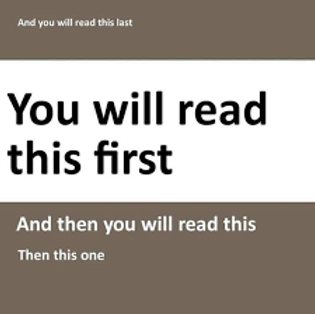
When you try to read this your brain already has the skills to add a Code Overlay. Try it!

Be aware of what you are doing when you try to read this. That's what we need children to be able to do.
Think of why you struggled with some of it.
What we do, so they all read with ease.
Introducing The Code Overlay, as and when the individual needs it.
7: The Learning Journey
Speech Sound Play
Monster Spelling Piano App
Mapped High Frequency Words
One, Two, Three and Away!
This is the basic overview.
You will also learn to use The Spelling Routine. This is delivered through a dedicated site and is used with older children who are instructional casualties.
This shows the basic overview for a child starting at age two or three, and the sequence that facilitates self-teaching. You will learn as much as they will. I train you, so that you can teach any child.
As you work through the process you will see how early attunement, access to print, and meaningful reading experiences work together to support the gradual shift from supported engagement with text to independent reading. Each stage builds the conditions needed for self-teaching to emerge, so reading becomes easier, more fluent, and increasingly driven by the child rather than the adult. You will see that with at least 1 in 4 children you can't skip steps!
If children can draw the Speech Sound Lines, ready for the pictures of the speech sounds to sit on, we know they are not at risk of dyslexia.
When children play the Monster Spelling Piano app they develop the phonemic awareness needed to prevent that risk.
Use Duck Hands, Lines and Numbers to build solid foundations. Word mapping for reading and spelling will be easier to learn.
At first glance, you may think these toddlers are learning phonics. They aren't. They are interested in ‘The Monsters’ and are taking in how speech sounds are ordered from left to right, and that when the sounds are blended, there is a word. This means they understand the role of letters without any real attention to them. At this point, the letters are simply pictures of the speech sounds and are not important. They would not be interested if the focus was on the letters, but this starting point is easy to understand. That’s the difference. We are building on their existing knowledge and understanding of the world.
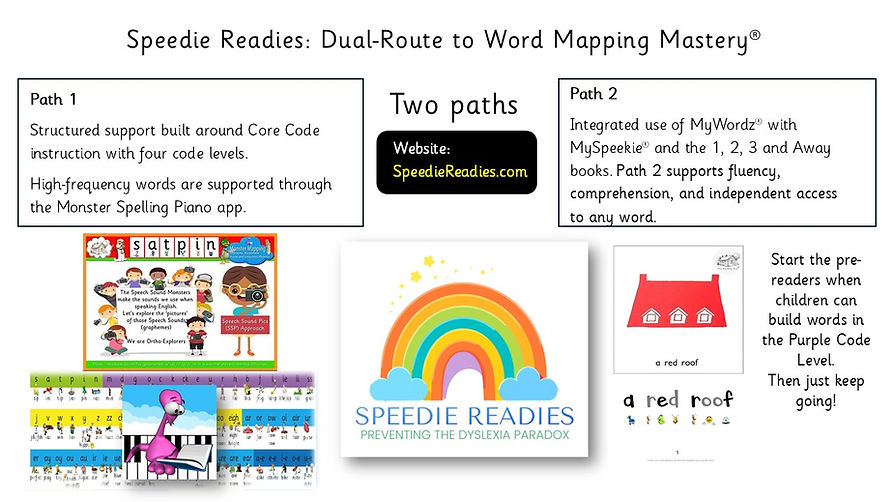
Speedie Readies: The Dual Route to Word Mapping Mastery®
• The Core Code: Connects speech sound processing to print through about 100 commonly used graphemes and more than 100 mapped high frequency words. This provides the essential foundation that allows learners to begin self-teaching.
• The Whole Code: Bi-directional word mapping within meaningful context eg the One, Two, Three and Away! series, set in The Village With Three Corners, that supports self-teaching and facilitates earlier orthographic mapping.
Path 1 - The Core Code - Introducing the High Frequency Graphemes
These are the English sounds. Even if non-speaking what matters is that they hear them when people are speaking!
These simply kick-start self-teaching
These are the high frequency graphemes. It's vital that they see them in words.
After watching, pause and have a go.
How and why are we introducing high frequency graphemes?
Phonics instruction is designed to help children connect letters and sounds because this is the foundation of reading and spelling. Although the meaning of words is vital, if children can’t figure out a word quickly they spend too much time working out individual words, and comprehension becomes difficult, even for a child who can easily understand text that is read to them.
The mapping (connecting letters and sounds) of single words is incredibly important. Some children figure it out with very little instruction because they have strong phonemic awareness, they can easily isolate the sounds and can blend and segment, so linking these skills to letters causes no difficulty. Even if they guess at a written word they automatically recode it by figuring out the mapping backwards. These children start to self-teach the mapping of words with very little explicit instruction.
Unfortunately, the children who don’t do this naturally, around 1 in 5 and not linked to intelligence, are going to struggle if they’re not identified early. This is why we screen even before children start looking at letters. If we know they have weak speech sound processing we need to spend more time strengthening this before adding lots of new graphemes (1 - 5 letters that sit together and map to phonemes - eg the word eight has five letters, but only two sound - so the mapping is <eigh> <t>. My Code Mapping tool will show this as eight as we use the black and grey contrast to show the graphemes.
If the focus is on adding new graphemes when they can’t easily segment and blend, they’ll start to struggle because of cognitive load. This is why the 10 day Speech Sound Play Plan in Reception is crucial. It gives teachers the opportunity to spot those at risk children and provide intensive phonemic awareness training before they start phonics, before adding that load, and before they start to think of phonics as really hard. Or before they start to develop strategies to 'fake' it - bright children do this, and slip through the cracks if teachers aren't sure how to check.
During the Speech Sound Play Plan we focus initially on six sounds that let them build more than twenty words with speech to print mapping, which then links directly to their phonics because the first group introduced is s a t p i n. Add in a few high frequency words and they’re decoding and writing full sentences before the middle of the first term. Restricting at risk children in reception to the s a t p i n group for a few weeks is worth the extra time because the focus is on blending and segmenting, with graphemes as the secondary focus. A child with strong phonemic awareness can make graphemes their primary focus. This difference is vital in the first term of Reception. Children who have good phonemic awareness and good memory for letters and the sounds they represent are able to focus on comprehension.
This starting point creates a great foundation from which to strengthen phonemic awareness and support personalised word mapping.
This stage gives us the opportunity to really focus on ensuring that children can BLEND!

This resource is part of the satpin handbook used in the Ten Day Speech Sound Play Plan.
We recommend the Monster Spelling Piano app
Here is a low resolution copy of the VPs to use for free!
This resources is part of the 60 free video lessons available on the SSP site - if you need to, take your time working through these.
https://www.speechsoundpics.com/icrwy
If they know the sound value of the graphemes (the letters) but can't blend, give them the word. Then ask them to decode it again.
The brain soon starts to connect the sounds and spoken word. If you don't give the word they will sit there feeling stupid and want to avoid it.
Give the word, and ask them to say the sounds and blend them. The ideal, however, is that they have a visual prompt picture when developing PA, so they don't need your help. They feel as though they did it alone. That's a great feeling!
During Path 1 the children are also exploring high frequency words.
Code Level Readers bring it all together. Use these alongside the Monster Spelling Piano app, but do start Path 2 when the children are working at the Yellow Code Level.
Letter and number formation is important. When ready use the satpin handbook and lessons shown here
If they don't know it, show it! Show the Mapped Word and then learn the word using The Spelling Routine.

Path 2 - The Whole Code - Moving Towards Self-Teaching

If they don't know it, show it.
SHOW Phonics for ALL Words.
Less Teaching.
More Self-Teaching.


