


One, Two, Three and Away! pre-readers have been mapped to Show the Code!
Making your child’s word mapping learning journey easier by showing how speech and print connect in the 36 pre-readers!




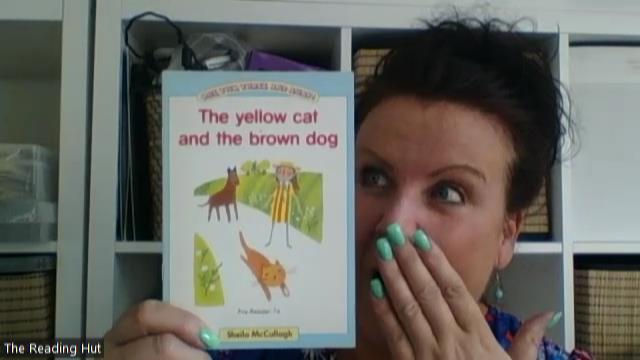


Want to read the regular One Two, Three and Away! books for FREE through your local library?
Ask your library to order them!
The Village with Three Corners® books are available for UK public libraries to order through their usual book suppliers, including Askews & Holts and Gardners. If your local library doesn’t currently stock them, ask a member of staff to submit a request for the books to be purchased by your library service. You can say:
“Please could you request The Village with Three Corners books for your children’s collection? They are available to libraries through Askews & Holts and Gardners. Here are the ISBNs"
The more parents who request them, the more libraries will know that families want them.
Phonemies® are phonetic symbols designed to enable toddlers to learn to read in English.
Show the Code: Which letters are the graphemes, and what is their sound value?
Phonemies® make the phonemes visible, so children can see how the sounds in a spoken word map to the graphemes in the written word.
If they’re not sure of a sound, they can click on the Phonemie® on the Phonemies® Screen in the Monster Spelling Piano app or MyWordz® to hear it.
🎹 Get the Monster Spelling Piano® app
💷 One-time price: £14.95
📲 Download on iPad (Apple):
https://apps.apple.com/gb/app/monster-spelling-piano/id6717616998
📲 Download on Android (Google Play):
https://play.google.com/store/apps/details?id=com.edcode.msp



Speedie Readies
Screen early. Support early. Every child deserves to communicate, read and spell with ease. Early years SEN, SpLD and SLCN specialists supporting families from the start.
Speedie Readies start self-teaching and developing word mapping mastery quickly, within weeks not years, and build a lifetime of joyful reading.
How? We Show the Code with Phonemies. Unsure of the word mapping? Which letters are graphemes, and which phonemes they map to? Check the MyWordz® Tech. Simple. We make the English orthography visible to all.
On this siite we focus on learning to read with The Village With Three Corners using 52 Code Mapped and Monster Mapped readers!
Become familiar with 'reading' long before knowing the Core Code.
"Follow the Sounds to Say the Word!"
Even three-year-olds can do this, and it addresses the very issues identified in children at risk through Dys-Code® screening. Amari is using the Speedie Readies resources in the Starter Pack.
He can do this because he knows all the 'Monster Sounds'.
If phonics doesn’t lead to self-teaching, it isn’t working. It should give every child the kick start the brain needs to take over.
For 1 in 5 children, it currently doesn’t. They don’t get to read for pleasure. Let’s change that. The Upsteam Team. Phonics Reform England (PRE)


If children are to understand how speech and print connect, their parents and teachers need to know too. Bidirectional Word Mapping Training should happen regardless of the phonics programme being used. Have you had any? Can you identify which letters are the graphemes and their sound values?
We offer Word Mapping Formula training through ShowTheCode.com as we also show adults how to use MyWordz® technology to check the mapping of words themselves, and teach them about the IPA so they understand how and why Phonemies® are used as phonetic symbols for orthographic learners: anyone learning to read, spell and communicate in English. Training covers the 60 Second Spelling Routine.

Ask your local library to stock the Village With Three Corners Series!
They are now published by The Reading Hut and libraries can order them through Gardners in England and also Australia.
Get in touch if you need help with that.
The Reading Hut® Ltd develops the Word Mapping Mastery® ecosystem, combining publishing, educational technology, teacher training and research to transform how children communicate, read and spell. Our Show the Code Approach uses MyWordz® with MySpeekie® technology, and Speedie Readies®, on this site, which brings the republished One, Two, Three and Away! children's books, including The Village with Three Corners, to life through orthographically mapped editions.


Ask your local library to stock The Village With Three Corners series so that you can read all One, Two, Three and Away! books at home, for free! UK libraries primarily order books and resources through specialist library wholesalers and suppliers, such as Askews & Holts, Gardners, Peters, and ProQuest.
Simply send them the list of ISBNs and request the books for your child. The library is the best place to go, to read the Roger Red-hat books. The Griffin Pirate stories and Tim and Tobias books can be read online here.
The Code Mapping® display is fully explicit using Emma Hartnell-Baker's Orthographic Code Mapping Tool.
Every word is segmented into graphemes, and each grapheme is shown as a complete unit across the word. The alternating colours are not decoration, they simply mark the boundaries between graphemes so the structure can be seen at a glance.
Very soon, Amari will be able to read books with regular text and no Code Overlay.

By the end of the 36 Pre-Readers, most children move on to the Intro Books and don't need to first see the sound value and which letters are graphemes that map to that sound. It's still there as an option: with the Phonemies® (Speech Sound Monsters) and graphemes shown, or just the graphemes (Sound Pics).
The One, Two, Three and Away! Pre-Reader books Show the Code.
We've given the brain enough of the code to take over the statistical learning.
Using the Monster Spelling Piano, children learn all of the core code assessed in the Phonics Screening Check (PSC).
They bypass a synthetic phonics programme, before starting school, and any parent can do it.
Learn about the Show the Code Approach using MyWordz ®on https://www.ShowTheCode.com !
Rather than waiting for children to learn enough grapheme–phoneme correspondences to access real books, we show them the code as soon as they understand what reading and spelling are, connecting speech and print.
We begin with the Speech Sound Play plan to check they can hear and identify the sounds. Through the SSP Green and Purple Code levels, they practise blending sounds and building words. They receive enough of a structured kick-start to begin the One, Two, Three and Away! books with confidence.Instead of restricting reading to tightly controlled texts until a threshold of GPC knowledge is reached, we make the full code visible. Children can see exactly which letters represent which sounds within real stories.
We begin with simple books, supported by The Code Overlay, so that every word is fully decodable for that individual child. As their understanding strengthens, the visual support is gradually withdrawn. The goal is not dependence on the overlay, but confident, independent reading.
This means the learning journey is self-paced and personalised. Children are not forced to wait until they “know enough” of the code to read with ease. The text is made accessible, and decoding becomes accurate from the outset.
By making the grapheme–phoneme structure explicit, we remove guessing and reduce cognitive overload. Children experience success early, build fluency more securely, and move steadily towards independent, self-teaching reading. Learn how to do this on ShowTheCode.com


When books are Code Mapped®, each word is broken down into graphemes, the letter groups that represent sounds. These are shown in order across the word so the child can see how it is built. The black and grey colours simply show where one grapheme ends and the next begins, and blue is used to show a split digraph.
When Phonemies are included, they show the sound each grapheme represents, helping the reader connect what they see on the page to what they hear in speech. This makes the structure of the word clear, not guessed.
When shown mapped pages, the code is already visible. This reduces the effort needed to figure out how letters and sounds connect, so children can focus on understanding and enjoying the text, and over time learn to see and use this structure without support. Some need very little support, others need much more This means no child is left behind, puzzled by phonics.


A Simpler Way to Grow Readers: Reading for pleasure with The Village With Three Corners


I started my career teaching infants after completing a BEd Hons specialising in the Early Years, 3 to 8. But I became a teacher long before that. I learnt by watching my incredible mother in her classroom, where she taught using The Village With Three Corners. It wasn’t a programme. It was a way of learning and growing into being lifelong readers who love to read.
That’s what Speedie Readies is about.
It’s not about rushing children into “learning to read” for academic outcomes. It’s about recognising that being a reader enhances lives, and finding it hard makes life harder. It really is that simple.
So let’s go back to a simpler time. A time before “evidence based” and “science of reading” became slogans that tried to package this deeply human process into a one size fits all programme to be followed “with fidelity”, as if children are all the same and teachers are too.
We aren’t. We love those little people. We want them to be happy, confident, and capable.
Simple.
Let’s bring back simple. Miss Emma
Children read more easily when the One, Two, Three and Away! series is introduced early. Our code mapping algorithm and Phonemies® make the structure of each word visible, so they can begin reading now and developing word mapping mastery instead of waiting for each part of the code to be taught.
When I taught Reception, all but one or two children were avid readers before Year 1. What was missing for the few who didn’t make that early progress? They needed activities that build strong phonemic awareness so they can hear the sounds in words, and they needed to be shown how those sounds connect to the letters.
Speedie Readies brings all of this together and gets children reading quickly and easily because the speech to print code is visible, the stories are engaging and the foundations are secure. Ask about 'My Reading Finger' - coming soon!
One in four children in England does not reach the expected standard in reading by age 11.
That figure has not shifted for years.
Decodable readers are mandated. They align to a teaching order. They work for many.
But “decodable” only works if the child can recognise the grapheme, say the sound, and blend it.
If they cannot, the book is not decodable to them.
At the same time, reading for pleasure is at its lowest level in twenty years.
So we built something different.
We have taken much-loved levelled readers and made them decodable to the child.
The 36 Pre-Readers and 16 Introductory Readers in The Village With Three Corners show the code.
Every grapheme and its sound value is visible using the Code Overlay and Phonemies.
Children continue learning systematic phonics but start these at the end of SSP Purple or Letters and Sounds Phase 2, Set 5.
They are no longer limited by the phonics that has or hasn’t been explicitly taught.
By Book 52, they no longer need The Code Overlay. They are in the self-teaching phase.
They move into the Blue Books as regular text and keep reading to the end of the 20 Main Readers.
This is a bridging model. We are making levelled readers decodable to the child. Useful for all
but life changing for neuodivergent children, especially those at risk of dyslexia.
Reception and KS1 should be about learning to read and wanting to read.
Preventing the dyslexia paradox. We support NeuroReadies. ALL children can be Speedie Readies!


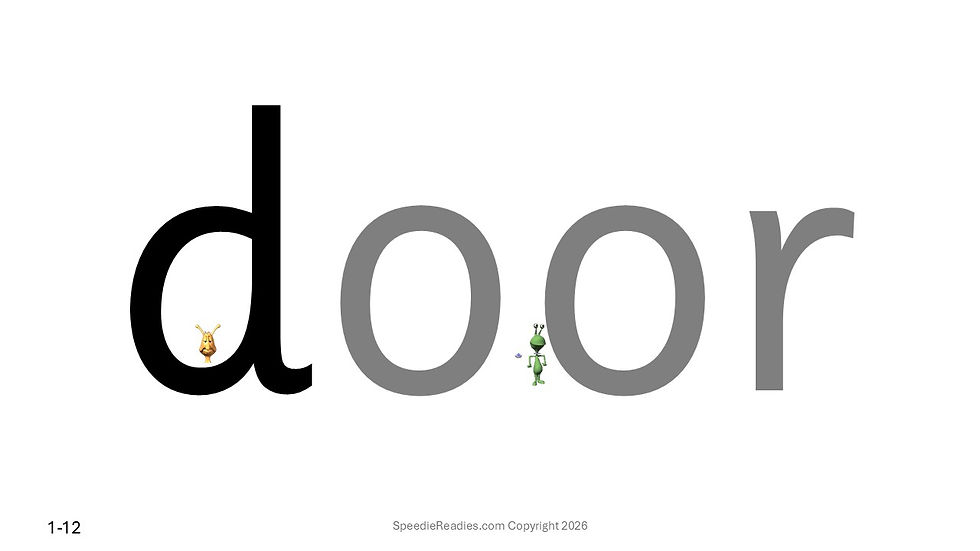


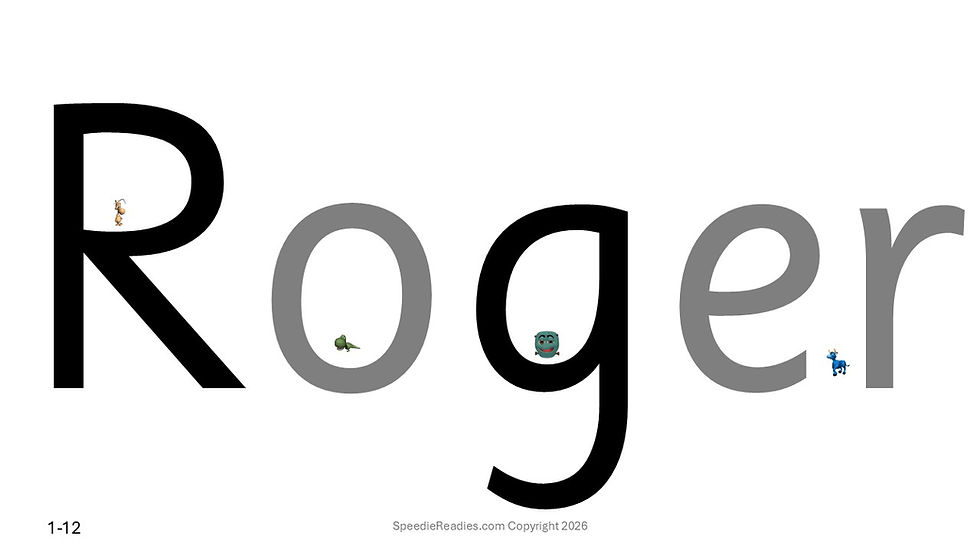


The Pre-Readers and Introductory Readers are mapped to show the English Pronunication Code from print to speech. We show the orthographic code through the English Code Overlay so that opportunities to engage deeply with language through discussion, retelling, and interaction are not lost in the focus on decoding every word. ECO makes the code visible: each grapheme corresponds to a phoneme, revealed through the Phonemies®. Nothing needs to be inferred or guessed. The code is already there, shown directly in the word. Every word becomes instantly decodable while still allowing children to focus on meaning and enjoyment. The first 52 books are orthographically mapped, enabling children to see which letters function as graphemes and the sound values they represent. There are over 100 within the full Village With Three Corners (One, Two, Three and Away!) series.
The books are being used in the Self-Teaching Reader touch-screen technology we are developing to bypass the over-teaching of phonics and enable parents and teachers to support comprehension, rather than navigating the English Pronunciation Code (EPC).
Parents can request that libraries stock these books in regular text, meaning there is no need to purchase them.
Emma Hartnell-Baker MEd SEN | The Neurodivergent Reading Whisperer® Project Lead, Phonics Reform England (PRE)
⭐ Speedie Readies: We show the code with IPA aligned Phonemies so every child can learn to communicate, read and spell with ease, because speech and print are connected for them in a clear and simple way, so that using written words to convey meaning becomes the focus. The first 52 books in the One, Two, Three and Away! series are orthographically mapped, and children use the word-mapping technology whenever they need it after that. Speech, spelling and meaning are bonded, which facilitates orthographic mapping, with the books targeting fluency and comprehension.


MySpeekie: Thought to Voice Technology
Speedie Orthographic Mapping: Show the Word Code with Speech Sound Monsters® (The Phonemies Family)
Monster Mapping® supports individual children to self-teach reading and spelling with speed and ease by showing children how speech and print connect for ALL English words, from birth. Less teaching, more self-teaching.
Some children will learn to read without needing a systematic phonics programme at school, if the right foundations are put in place early. When children are supported in the early years to notice speech sounds, understand how spoken words link to print, and build word knowledge through meaningful routines, reading can become self-teaching before school even begins. This does not happen by chance. It is about giving children what fluent readers naturally acquire, from birth, so that when they encounter print, reading develops with ease rather than effort. Parents play a crucial role in creating these conditions long before formal instruction starts.
Speedie Readies is a world-first word mapping system, used alongside existing synthetic phonics programmes to strengthen how children connect speech and print. It combines Village with Three Corners pre-mapped books, a speech–print mapping algorithm, and training that shows adults how to respond differently to different learners. The system supports bidirectional word mapping at scale, helping children become self-teaching readers and spellers by making the link between speech, spelling, and meaning visible.
We are not explicitly teaching multiple graphemes and hoping children will somehow work out the rest for themselves. Too many children do not. Instead, we make the full code visible in books so children can teach themselves through reading and spelling.
Speedie Readies shows parents, tutors, and teachers how to help children map speech sounds to spelling, supporting independence in both reading and spelling. The training explains what separates children who learn to read and spell with ease, often with little explicit teaching, from those who will struggle if all they receive is a phonics programme limited to a small set of correspondences, high-frequency words, and decodable readers. For many children, that is not enough.
Parents need to understand which group their child is in, ideally before any formal teaching of reading and spelling begins. This is not linked to intelligence. Around 1 in 5 children start school at high risk of struggling to learn to read and spell without specific one-to-one support in Reception and KS1. This happens regardless of how often parents read to them or how articulate they are.. It is much harder once a child has already experienced difficulty, as disengagement can set in quickly. If a child has been taught but is struggling, Speedie Readies is designed to ensure that anyone with a positive connection to the child can help get them back on track and interested again.
Learning to read and spell is grounded in decades of research into speech processing, memory, and word learning. While there are well-established developmental principles underpinning how children acquire written language, the support required varies according to the child. Some children arrive with strong phonemic awareness and can readily segment and manipulate speech sounds. Others do not, and without explicit support to build this foundation, they are unlikely to move into self-teaching through reading and spelling alone. Seff-paced learning is essential.
A child with strong phonemic awareness does not need the same level of support to isolate, segment, and blend sounds. A child who already recognises some graphemes can move quickly into the pre-readers, often after a short period playing with the Monster Spelling Piano app and learning the monster sounds. Children who can decode reasonably well and read phonics books also need to move into the readers as soon as possible, as they need to see the full code and learn strategies such as re-coding a word initially inferred from context or syntax.
Emma Hartnell-Baker (Miss Emma) is known for identifying the most efficient pathway into reading and spelling for children who have not yet begun formal orthographic learning, including very young children, and for pinpointing what is blocking progress for children who have already been taught. She shows teachers, tutors, and parents how to do this using her unique talk-aloud approach, explaining in real time what she is noticing, what decisions she is making, and why. Miss Emma, the Neurodivergent Reading Whisperer®, provides training courses to help parents understand what their child needs next and how to better support their learning. She also supports Reception teachers to strengthen their synthetic phonics programmes, and teachers of KS2 children who are not yet reading and spelling with ease. This level of real-time analysis and responsive guidance, focused on achieving Word Mapping Mastery®, is not offered elsewhere. Explore on-demand training on the Phonics Reform England platform.
⭐ We show the code so every child can learn to speak, read and spell with ease.
Phonics Reform England focuses on improving phonics so it works for all children, with particular attention to the one in five who are most at risk of struggling to learn to read. Systematic, Synthetic Phonics programmes are designed as if all children learn to connect letters and sounds in the same way and at the same pace, and this is why we are speaking out for children, because we know that what is happening now is not working for all of them.
Miss Emma, The Neurodivergent Reading Whisperer® Join me @ Phonics Reform England


Show the Code : Every Child Mapping Words to Read and Spell QUICKLY and easily!
Unsure? Check the Word Mapping Tech.
Suitable for toddlers and non-speaking children, and life-changing for neurodivergent learners and those screened as at high risk of dyslexia.
Dyslexia risk screening in Reception, with prevention to avoid the intervention. Ten Minutes a Day, With a TA. Prevent the dyslexia paradox. No more waiting to fail. Visit PhonicsReformEngland.com.
Research in cognitive neuroscience has shown that the brain’s capacity to form the neural connections linking speech, print, and meaning is greatest before the age of seven. We can prevent reading and spelling difficulties, but by eight prevention is no longer possible and remediation is required. This is not the child’s fault. It is a missed opportunity. This is the dyslexia paradox. The dyslexia paradox refers to the well-established finding that the best time to prevent reading difficulties is in the early years, before children start school or in Reception, when the brain is most responsive to learning how speech maps to print. However, dyslexia is often not identified until children have already failed to learn to read, typically after the age of seven, when this period of greatest neuroplasticity has passed. This means that the children who most need early support are the least likely to receive it in time. As a result, early prevention is missed, and later intervention becomes more difficult, more time-consuming, and often less effective.
Help us support class teachers, push back against wait-to-fail policies and roll out Speedie Readies in Reception and Year 1. Ten minutes a day for a few weeks with an awesome TA is all that’s needed. Upstream screening and support is quicker, cheaper, and far more effective than remediation later on. And children LOVE the 100+ stories! They don't just feel proud of being able to read easily; they experience the true joy of reading for pleasure.
The Early Dyslexia Screening Centre was launched to shine a spotlight on the power of upstream screening.
Ask about dyslexia risk screening with SpLD specialist Emma Hartnell-Baker.


Speech Sound Mapping targets the phonological processing differences linked to dyslexia, promoting alternative neural routes that support successful reading acquisition.


Children who learn to map words early achieve Word Mapping Mastery quickly and learn to read with confidence.
Speedie Readies: Preventing the Dyslexia Paradox. An initiative from The Reading Hut
The Speedie Readies word mapping system embraces linguistic and neurodiversity so that every child can find joy and confidence in reading.

